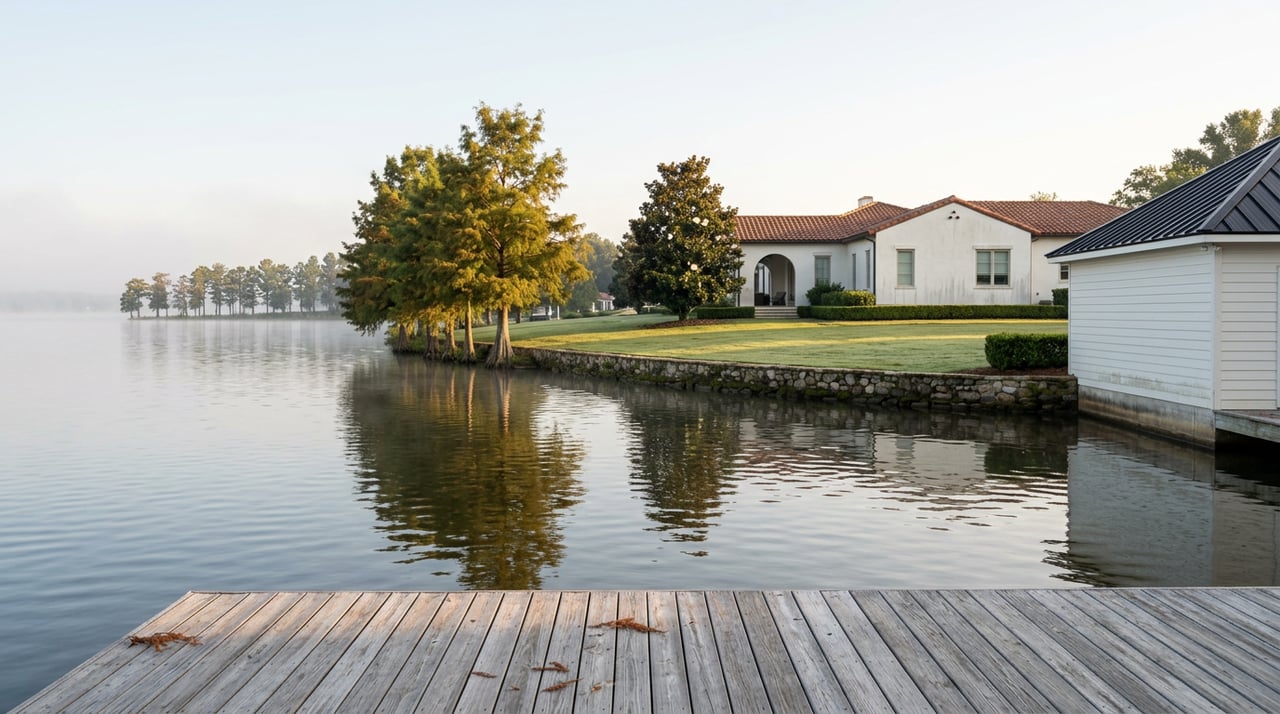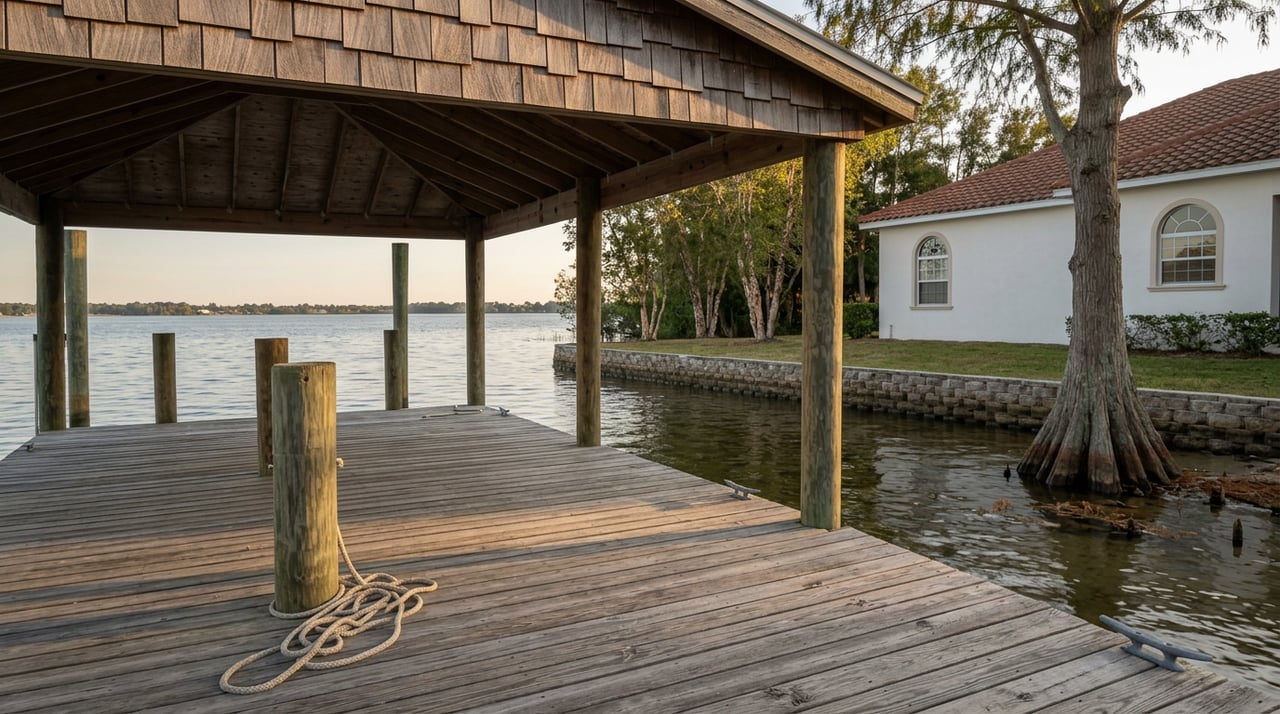
A buyer walks the dock at a Bracey listing, notes the boathouse is solid, the pilings look recent, and assumes the hard part is over. Somebody already got this permitted. That assumption holds up fine on plenty of Lake Gaston shorelines. It just doesn't hold up here, on the Virginia side, the way most people expect.
Dominion Energy owns the lake bed and the shoreline up to the High Water Mark on every foot of Lake Gaston, whether the property sits in Warren County, North Carolina or Mecklenburg County, Virginia. Anyone who wants to build or rebuild a pier, dock, boathouse, or ramp needs a shoreline use license from Dominion first. That part is consistent lake-wide, and it's the part most buyers already know to ask about.
What catches people off guard on the Virginia side is the second signature. In Mecklenburg and Brunswick counties, the same activities that need a Dominion license also fall under a federal authorization called Regional Permit 22, issued and administered by the U.S. Army Corps of Engineers' Norfolk District. The Corps confirmed this scope directly in a 2023 public notice covering RP-22's reissuance, describing construction of piers, boat docks, boat ramps, and boathouses within the Virginia portion of Lake Gaston. That's not a formality layered on top of Dominion's process. It's a separate federal review with its own conditions, and it applies specifically because Bracey sits on the Virginia shoreline.
What Dominion's license covers, and where it stops
Dominion's construction and use procedures spell out a lot of what happens shoreline-side: how far a structure can extend past the property line, how close it can sit to a neighbor's dock, what counts as routine maintenance versus a rebuild that needs new paperwork. The rules are the same whether the deed sits in North Carolina or Virginia, because Dominion's ownership of the lake doesn't change at the state line.
Where it does change is what else has to sign off. On the North Carolina shoreline, additional oversight generally runs through state water quality agencies and the standard federal permitting pathway most lake projects nationwide use. On the Virginia shoreline, in Mecklenburg and Brunswick counties specifically, that federal pathway is RP-22, and it exists because the Norfolk District decided the volume and pattern of dock construction on this stretch of the lake warranted its own regional permit rather than handling every project as a one-off federal review.
For a buyer, that means the same-looking boathouse in Bracey and a nearly identical one across the state line in Littleton or Macon may have cleared two different regulatory paths to get built, even though both needed Dominion's blessing.
The comparison that actually matters at closing
| North Carolina shoreline | Virginia shoreline (Bracey, Mecklenburg and Brunswick counties) | |
|---|---|---|
| Shoreline ownership and base license | Dominion Energy, all structures | Dominion Energy, all structures |
| Federal review layer | Standard nationwide federal permitting pathway | Regional Permit 22, U.S. Army Corps of Engineers, Norfolk District |
| Who administers the federal layer | Corps district covering North Carolina waters | Corps' Norfolk District, specific to Lake Gaston's Virginia portion |
| State environmental review | North Carolina water quality agencies | Applicable Virginia review, layered on top of RP-22 |
This is the piece that doesn't show up on a listing sheet or a portal page. It shows up when a buyer's attorney or closing agent starts asking for permit documentation and finds a Dominion license but no record of whether the dock's original construction was ever run through the Corps' Virginia process. That gap doesn't necessarily mean the dock was built improperly. It means someone needs to chase down the paperwork before it becomes the seller's problem or the buyer's problem, and it's a much easier conversation before the contract than after.
The grandfather clause that gets misread more than any other rule
Dominion's procedures allow property owners to maintain existing structures, docks, boathouses, bulkheads, riprap, without pulling a new permit, as long as the repair addresses 50 percent or less of the structure. Cross that threshold, and the rules flip. More than half destroyed means the structure has to come down, and rebuilding requires a fresh permit under whatever regulations are current at the time, not the ones in place when the original structure went up decades earlier.
This matters more on older Bracey docks than newer ones. A boathouse built in the 1980s or 1990s was often licensed under looser standards than what's enforced today. As long as it's only ever received routine upkeep, it keeps its grandfathered status. But if a prior owner replaced most of the decking after storm damage, or rebuilt a bulkhead that took a hard hit, that repair may have quietly pushed the structure past the 50 percent line, which means it should have triggered a new permit application, whether or not anyone filed one.
A few other details worth knowing before a Bracey closing:
- Dominion does not allow new bulkheads anywhere on the lake, only maintenance of ones that already exist. A seawall that needs full replacement isn't a simple swap.
- Riprap, the stone used to stabilize an eroding bank, still requires its own permit even though it's one of the more common shoreline fixes.
- Vegetation control has real limits. Willow weed along the shoreline is protected under Dominion's license agreement with federal regulators, so it can't be pulled or sprayed, a detail that surprises more than a few new owners who expected to clear their waterline the way they would a yard.
None of this is unique to any one lot. It's the operating reality for anyone who owns shoreline in Bracey, and it's worth walking with eyes open rather than discovering it during a post-closing repair.
What this looks like on the ground in Bracey
Bracey sits in the lake's Northwest Quadrant, home to Poplar Pointe Marine on Poplar Creek, a full-service marina that's been under the ownership of Kevin and Shawnna Graham since 2020 and includes the Shady Shack Grill, a familiar stop for anyone gassing up or grabbing lunch on the water. A short run north puts you near Washburn's on Pea Hill Creek, another local fixture for fuel and food during a long day out. Both marinas operate their own docks and boathouses under the same layered permitting most private waterfront owners face, which is a useful reminder that even commercial operators on this shoreline answer to Dominion and the Corps, not just one or the other.
For a buyer evaluating a private dock nearby, the practical move is simple: ask for the Dominion shoreline license before the inspection period closes, and ask specifically whether the structure's original construction or any major repair was run through the Corps' Virginia process. If the seller has the paperwork, it's a five-minute conversation. If they don't, it's worth involving someone who knows which questions to ask Dominion's shoreline program and how to read what comes back.
A few questions worth asking before you write an offer
Does the Dominion shoreline license transfer to a new owner automatically? Licenses run with the structure and the property, but it's worth confirming the license is current and in good standing rather than assuming it carries over without any documentation check.
If I want to add a boat lift to an existing dock, does that trigger new permitting? It can. Adding equipment to a structure is treated differently than routine maintenance, and it's the kind of project that should be checked against both Dominion's rules and the Corps' Virginia requirements before work starts, not after.
Who do I actually call with shoreline questions once I own property in Bracey? Dominion's Reservoir Program Manager handles shoreline management questions for Lake Gaston, and the Lake Gaston Association maintains updated contact information for the current manager on its site.
Buying on the Virginia side of Lake Gaston isn't more complicated than buying on the North Carolina side. It's differently complicated, and the difference is exactly the kind of detail that's easy to miss until it's expensive. If you're looking at a dock in Bracey and want someone who's walked this permitting path before, Pamela Hale treats every question about shoreline history the way she'd want it handled for her own family: thoroughly, before the contract, not after. Start Your Lake Gaston Journey and bring the dock questions with you.