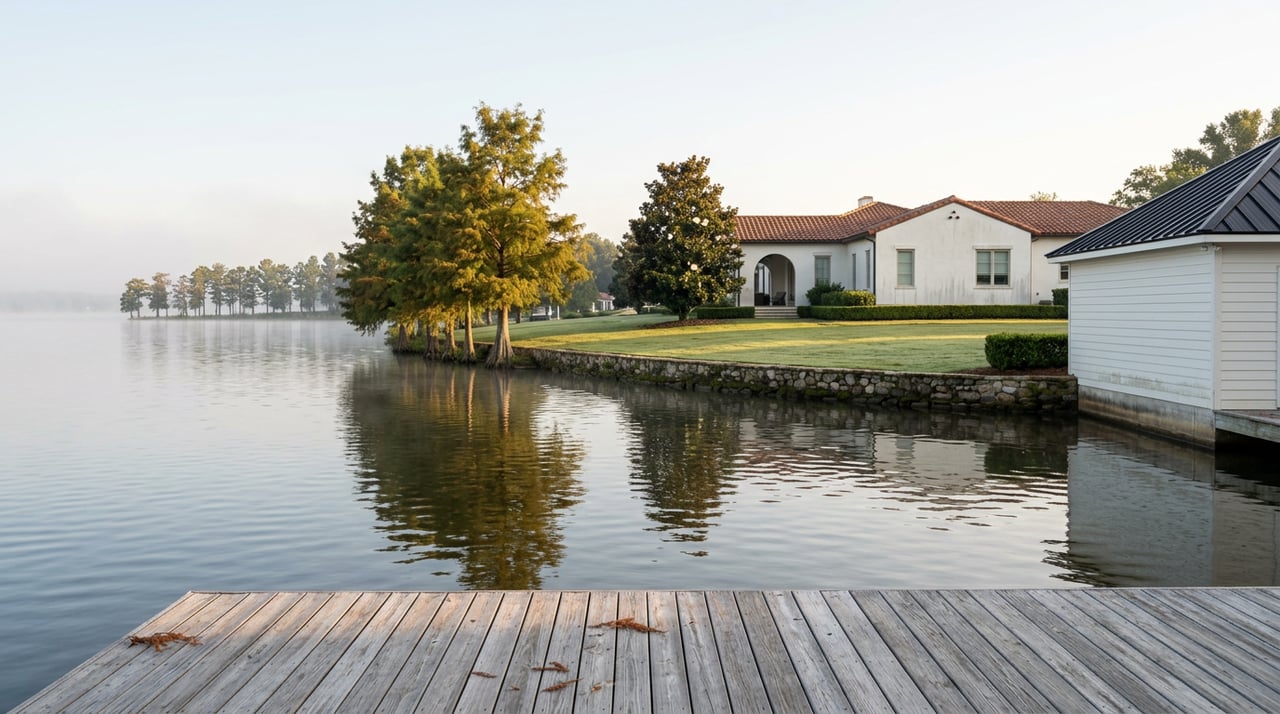
On a Wednesday evening this spring, the west side of the Roanoke Wildwood Volunteer Fire Department filled up the way it does several times a year. Not for bingo, though that is what the room is built for. The chairs were pulled into rows facing a projector screen, coffee was poured from a thermos someone had brought from home, and by 7 p.m. the Lake Gaston Water Safety Council had a crowd. The agenda that night was aquatic plants: what is growing where, what is being sprayed and when, and what any of it means for the water people around here swim in, dock in, and pull their grandkids across on a tube.
If you live in Henrico, you already half-know this. What you might not have put together is what it says about the place. Henrico has no mayor, no town council, no zoning board of its own. It is unincorporated Northampton County, a scattering of homes along River Road and the coves that branch off it. And yet, several evenings a season, its volunteer fire hall becomes the closest thing Lake Gaston has to a capitol building. That is the thing worth understanding about living here: the civic life of this community does not run through a town office. It runs through a bingo hall and a boat ramp.
A fire hall filling in for a town hall
The Lake Gaston Water Safety Council has met since 1989, when Joe Peterson, then with what is now Dominion Energy, pulled together a group of lake residents who wanted one job done well: keep people safe on the water. It has stayed a volunteer, dues-funded operation ever since, five dollars a person or ten dollars a family, and its meetings usually rotate to the Kennon House Restaurant over in Gasburg. But this past April, the meeting moved to Henrico, to that fire department bingo hall on River Road, because the program on the docket, aquatic plant management, is the kind of subject that pulls people out of five counties and two states.
The presenter that night was Jessica Baumann, the NC State Extension Associate who has become the closest thing Lake Gaston has to a plant doctor. Her talk covered the year's treatment plan for hydrilla and lyngbya, the two nuisance species that have shaped how this lake looks and feels for decades. It is a strange kind of local celebrity status, an extension scientist whose annual report draws a full house in a volunteer fire department, but that is what happens when the subject is the water itself.
What actually got decided, and why your dock cares
Here is the part that matters if you swim, ski, or fish anywhere near Henrico. The Lake Gaston Weed Control Council's 2026 hydrilla program targeted 326 acres for treatment, spread across three consecutive monthly rounds in May, June, and July. Applicators from PLM Lake & Land Management Group worked the shoreline with boat-mounted units, broadcasting herbicide pellets rather than spraying, and residents inside those treatment zones were asked to hold off on irrigation for a stretch afterward. Alongside the herbicide work, Dominion Energy funded roughly 1,300 sterile grass carp for release into the lake this year, the long-game biological half of a strategy that has been running for more than two decades.
None of that is abstract if you have watched hydrilla mats choke a cove you used to swim in without thinking twice. The lake's own weed control council has been candid that eradication is not realistic. Hydrilla tubers can sit dormant in the sediment for up to seven years before sprouting again, which is why the same 300-plus acres tend to show up on the treatment map most summers rather than shrinking to zero. What the meeting in Henrico's fire hall settles, in practice, is which coves get the pellets this year and which get left to the grass carp.
If you want to see it up close rather than take it secondhand, the timing works out well. The lake's volunteer vegetation survey runs from August 25 through October 31, and it depends on residents willing to walk their own shoreline and report what they see. It is the same kind of data that feeds next year's treatment map, gathered by the people who actually live with the results.
The other reason people show up
Plant management is not the only business that gets done in that room. The Water Safety Council also runs the Children's Life Jacket Loaner Program, and Henrico has two of the drop points: Washburn's Marina and Sherwood Forest. If you have out-of-town family arriving without gear, or a kid who has outgrown last year's vest, those are the two names to remember. Washburn's does double duty as the neighborhood's other institution, a marina and gas dock that has built a local reputation less on the fuel pumps than on its burgers, the kind of place where a boat trip and a lunch stop are the same errand.
For anyone who wants formal instruction rather than a loaner vest, Flotilla 93 teaches a boating safety class the third Saturday of every month from March through September. It is the same kind of unglamorous, recurring infrastructure as the fire hall meetings: nobody is marketing it hard, but it has been there every season for years, run by people who live on this water themselves.
Wear a life jacket and boat sober.
That line closed out the April meeting notice, five words that do more work than most safety campaigns manage in a full brochure.
The calendar nobody prints but everyone knows
There is a rhythm to all of this that a newcomer would not guess from the outside. The Water Safety Council meets the last Wednesday of the month during boating season, and the evening has its own small ritual: a Social Half Hour at 5:30, a Dutch-treat dinner at 6, and the meeting itself after that. No meetings run from October through February, the lake's quiet stretch. September traditionally closes the season with a Pig Pickin', which functions less as a meeting and more as the community's own end-of-summer marker, the way other towns might close with a festival or a parade.
That is the pattern worth sitting with. Henrico does not organize its year around a chamber of commerce calendar or a Main Street events board, because it does not have either. It organizes around the lake's own institutions: the Weed Control Council's treatment schedule, the Water Safety Council's Wednesday meetings, the volunteer survey window that opens every August, the loaner program at two marinas that most people found out about from a neighbor rather than a website. A place without a town hall still finds a way to govern the things that matter to it. It just does the governing in a bingo hall, with a projector and a thermos of coffee, and calls it a Wednesday.
If you are the kind of person who already shows up to that meeting, or wants to start, the Lake Gaston Water Safety Council welcomes visitors without a membership card required, and the vegetation survey that opens August 25 could use another set of eyes on a shoreline somewhere near your own dock.
For more on what makes life around Henrico and the rest of Lake Gaston worth paying attention to, Pamela Hale keeps a close eye on this community, on and off the water.