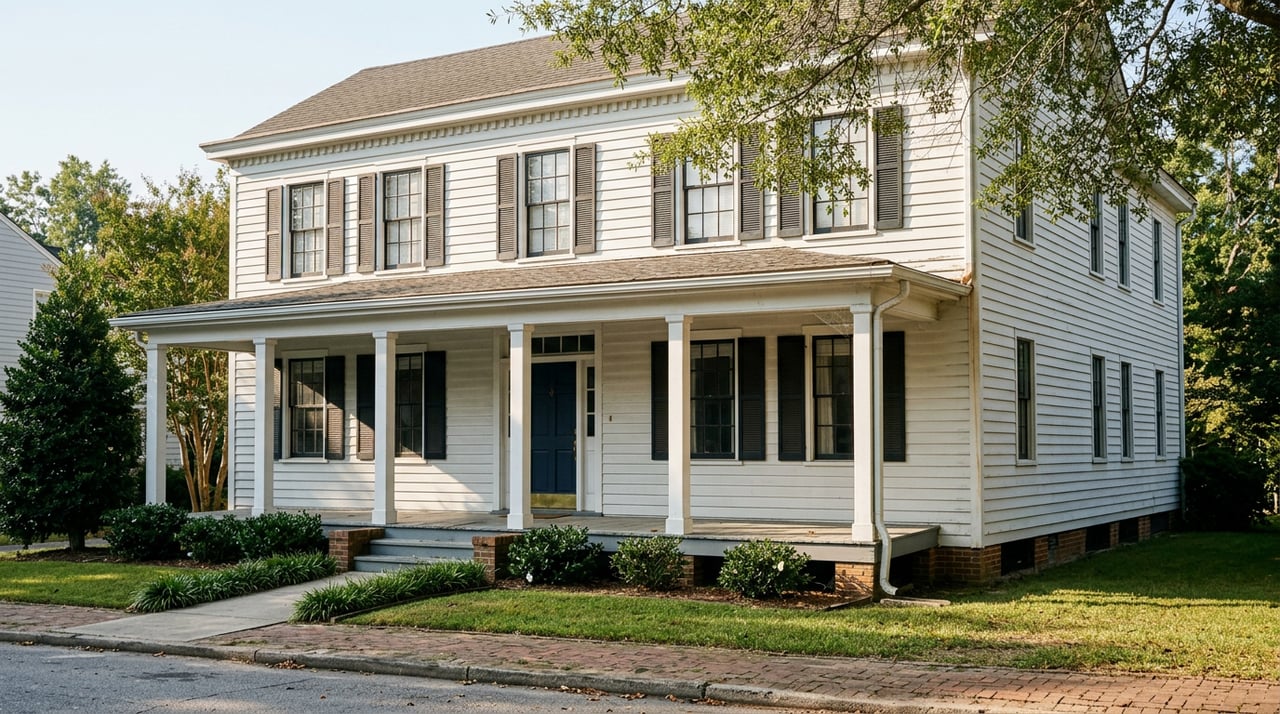
A buyer walks through a circa-1900 two-story on one of Warrenton's historic streets, falls for the wraparound porch and the bones underneath, and starts pricing out a rehab before the ink is dry on the offer. New roof, updated kitchen, maybe $30,000 to $40,000 in work. The math looks straightforward until it isn't. In North Carolina, the state will credit 15% of that spend back to you if the property is inside a National Register historic district and you follow the rules in the right order. Get the order wrong and the credit disappears, no matter how historically accurate the finished work turns out to be.
That order, not the purchase price, is the part of this transaction that catches people off guard.
What "historic district" actually means here
Warrenton's downtown and surrounding residential blocks make up a National Register historic district first listed in 1976. In 2024, the state added new documentation to that listing, extending the period of significance back to roughly 1783 and forward to 1971, and expanding the boundary to include early-to-mid-twentieth-century buildings and African American resources that weren't part of the original 1976 paperwork. The town's own history traces back to Jacob W. Holt and Albert Gamaliel Jones, the two builder-architects responsible for much of the Federal, Greek Revival, and Italianate housing stock that still lines streets like Main, Bragg, and Front. Named contributing structures like the Falkener House, the Peter Davis Store, and the Sommerville-Graham House anchor the district's National Register file.
This matters practically because a property's status as a National Register listing or a contributing building within that district is the gate you have to pass through before any tax credit conversation starts. If a house isn't on that list or doesn't contribute to the district, none of what follows applies to it.
The credit, and the two-part filing that guards it
North Carolina's non-income-producing historic rehabilitation tax credit gives homeowners a 15% state tax credit on qualified rehabilitation expenses for owner-occupied residential properties, as long as the work exceeds $10,000 within a 24-month period. The credit can be carried forward for nine years if you can't use all of it in the year the home is placed back in service.
Here's the part that trips people up. The application is a two-step process, and the steps are not interchangeable in order:
- Part A, filed before work begins. This documents existing conditions and describes the proposed scope of work, with before photos and plans as needed.
- Part B, filed after work is complete. This documents the finished rehabilitation with after photos and confirms the building's status as a contributing structure.
The State Historic Preservation Office reviews both parts against the Secretary of the Interior's Standards for Rehabilitation, the same federal guidelines used nationally since 1976 to judge whether a renovation preserves a building's historic character or erases it. A buyer who guts a kitchen or replaces original windows before Part A is on file has, in effect, already made the decisions the credit was designed to review. There's no retroactive version of this application. Work done first is work the state never had a chance to evaluate, and unreviewed work doesn't qualify.
Local review runs on its own calendar
Warrenton layers a second process on top of the state one. The town's Historic District Commission has its own design guidelines covering roofs, exterior walls, windows, porches, fencing, signage, and even energy retrofits, and the commission typically meets on the last Monday of each month. Getting on the agenda requires submitting an application at least fourteen days ahead of that meeting.
Stack these two clocks together and the practical timeline for a rehab project looks less like "buy the house, start demo" and more like buy the house, file with the state, wait for a design hearing that only happens once a month, and only then pick up a hammer. A buyer who closes in early August and wants to start work immediately could be looking at a September Historic District Commission meeting before local sign-off, on top of whatever turnaround the state review adds.
What this looks like in dollars
As of August 2026, Warrenton's median list price sits at $242,000, down slightly year over year, with homes spending a median of 93 days on the market before going under contract. That slower pace actually works in a rehab buyer's favor here. Unlike a hot market where a delayed start costs you a competing bid, Warrenton's pace gives a buyer room to file Part A, get a design hearing on the calendar, and start work without racing anyone else to the punch list.
On the money itself: a $35,000 rehabilitation that clears the $10,000 threshold and gets Part A filed before the first contractor shows up could return roughly $5,250 as a state tax credit, assuming the completed work is certified through Part B. Skip the sequence and that $5,250 simply isn't available, regardless of how well the finished house turns out.
| Scenario | Tax credit outcome |
|---|---|
| File Part A before starting work, complete Part B after | Eligible for 15% state credit on qualified rehab spend |
| Start work first, file paperwork afterward | Not eligible, no retroactive review |
| Spend under $10,000 in a 24-month window | Not eligible, threshold not met |
| Property not listed or not a contributing structure | Not eligible, district status required |
The downtown walkability that draws buyers to these streets in the first place, the porches within a short walk of local spots, the sense of a town built around a courthouse square, is real. But it's a separate question from whether a specific renovation pencils out financially. One is a lifestyle decision. The other is a paperwork decision, made weeks before the lifestyle part even starts.
Frequently asked questions
Does the credit apply if I'm renovating a rental property instead of my own residence? The 15% credit described here is specifically for owner-occupied, non-income-producing properties. Income-producing historic rehabilitations fall under a separate state and federal program with different percentages and thresholds.
Can I claim the credit if I already finished the renovation before I knew about it? No. Because Part A has to document existing conditions and proposed work before construction starts, work completed without that filing in place cannot be certified after the fact.
What if my rehab budget comes in under $10,000? The threshold is cumulative rehabilitation spending exceeding $10,000 within a 24-month period. A single small project under that line doesn't qualify on its own.
Does every house in Warrenton fall inside the historic district? No. Eligibility depends on whether the specific property is individually listed on the National Register or identified as a contributing structure within the district boundary, which is worth confirming before you build a renovation budget around the assumption.
If you're weighing a historic-district fixer against a newer build elsewhere in Warren County, or trying to figure out whether a specific address actually carries contributing status, that's exactly the kind of question worth working through before you write an offer, not after. Pamela Hale works this market street by street and can help you sort out what a given property actually qualifies for before the paperwork clock starts running. Start Your Lake Gaston Journey.